Digimon Story Cyber Sleuth Complete Edition PVP is definitively unique amongst other RPG games that feature PVP. Players don't go back and forth swapping turns with each other to issue commands, instead, the commands that they issue cost them speed which then influences how long it will be until that digimon has another turn to issue a command in the future, meaning that more costly yet powerful commands come with an inherent cost to committing to using them in battle. The balancing in the PVP meta that was designed by the game's dev team creates an environment unlike other monster tamer RPG battlers where there are no dominant strategies or character choices that invalidate other strategies fully.
CSCEPVP does however require a higher degree of knowledge and intention than many competing RPG PVP systems due to its unique game mechanics, and because every little decision matters when deciding victory. This article will explain the most important mechanics that a new player will need to understand in order to compete in CSCEPVP, as well as review the exact numbers behind the most important skills used in battle. General references to common strategies and playstyles will be made as well in order to inspire any hopeful new tamer with understanding and confidence to create their first teams.
Speed, CD, and the Timeline
Reviewing the timeline throughout a battle will immediately increase your skill as a tamer in CSCEPVP. When hovering over any command, the timeilne updates to preview the result of choosing that command for your turn, which lets you visualize in real time how your turn is going to effect your ability to remain present in a battle and take more turns afterwards.
Across this site you will see a stat called CD, which is hidden within the actual game, but we've made it visible to you in order to help new players improve quickly without having to memorize numbers. By default, the timeline assumes other digimon will spend 10000 CD on their turn, though some commands have lower than 10000 CD, such as guarding, or using a skill such as Mental Charge. Conversely, skills that contribute massive results to a battle such as Final Shining Burst or Perfect Revival come with great CD costs, making their use an important decision to be made during battle.
The way that the SPD stat interacts with the timeline is that at the end of every turn, each active digimon's CD is reduced by CD/(Digimon's SPD + 200) until that digimon's CD hits 0. if multiple digimon's CD hits 0 at the same time, then a tie is resolved based on their SPD stat, randomly choosing one if they share the same SPD stat. When a digimon's CD hits 0, they take a turn. Because the formula adds 200 to the SPD stat during calculation the ability of digimon to participate in the timeline is greatly averaged compared to how the mechanic worked in the first releases of Cyber Sleuth before complete edition/hacker's memory when the 200 points were added to the formula.
This means that lower SPD digimon still take turns around the same amount of time as higher SPD digimon, and that CD and timeline management plays a larger role than the digimon's SPD stat. That being said, the first timeline order in a battle entirely comes down to the SPD stat of the starting active digimon, as no digimon has taken a turn yet and therefore have the same starting CD.
This is all to say that a great tamer in CSCEPVP doesn't just take whatever turns the timeline gives them, they manipulate the timeline through smart investments of turns and CD usage so that they find favorable and/or frequent turn orders on the timeline to enable them to survive attacks, line up XROSS COMBOs, or stop enemy digimon before they do anything dangerous. This skill will take a long time to develop for newer players, but remaining conscious of this feat will help you grow your ability to recognize the opportunity that exists in mastering the timeline mechanic.
Damage Calculation, Healing, and Revival
Unlike other RPG PVP battling systems, death is not the end in CSCEPVP. Revive and Perfect Revival are two of the most important staple skills in the game. Revive not only removes the death status condition from a targeted dead active allied digimon, but heals it for 5% of its max HP stat. Perfect Revival does the same thing but for all dead active allied digimon, and heals them for 25% of their max HP stat, but at a much higher CD and SP cost. Because these skills are so universal, killing a digimon is only meaningful if that digimon's CD is low, its allies aren't ready to revive it soon after on the timeline and further support it with heals or protection with skills like Safety Guard, or if its the final knockouts of the battle.
Also unlike other games, any digimon can learn any skill, except for the signature skills of other digimon (and in a very rare few cases some digimon cannot learn other skills). This means that digimon aren't restricted by limited movepools or made or broken by access to powerful staple skills. At the same time, this means that both teams have full access to the most important skills to enable their team to fight at full power, so revival and healing should be expected when battling against an opponent.
When it comes to healing, there are two main healing skills that any digimon can learn in Final Heal and Final Aura. They each serve different niches, and are both powerful staples in PVP. Final Heal restores the HP of a living allied digimon by 1.5x the healer's INT stat. there is no variation to this number, you can technically deduce the exact INT stat of your opponent if you're observant enough. Final Aura comes with a higher SP cost and only heals for 1.2x the healer's INT stat, but it heals all active living digimon. This healing value is much lower than it is in the PVE story mode in the game, but that's because the damage and healing values are balanced specifically for PVP when battling other players. These values can be significantly increased by XROSS COMBOs which we will go into later in this article.
Lastly, the damage formula is as follows for each of the different damage types.
Physical Damage: 1.5 x (Attacker's ATK) x Skill's Power x Adjustments / (Defender's DEF)
Magical Damage: 2.25 x (Attacker's INT) x Skill's Power x Adjustments / (Defender's INT)
Penetration Damage: (Attacker's ATK/INT) x Skill's Power x Adjustments (Medium: 1; Strong: 1.8; Extra Strong: 2.5)
This mainly represents the fact that DEF is often an underinvested stat, creating an asymmetrical dynamic where INT is the "default" stat in a way, as it serves the dual purpose of dealing magical damage and reducing magical damage taken, as well as bolstering the ability of healing skills on top of that. But if the meta revolves around INT, then ATK becomes a valid way to bypass the INT of enemy digimon, therefore ATK always secures at the very least a rogue or anti-meta niche in PVP. But because DEF is often times a stat that sees little stat investment because it only serves to protect against a stat that otherwise isn't seen often, ATK therefore becomes an even more valuable investment for a team as DEF investments appear less often. A new player may think that Penetration damage would fill this niche, but due to the equipment Memetan Replica, which we will go into more detail with later, Penetration damage is relegated to a more niche risk-reward focused damage type. Because of this intricate balance of damage types, it tends to be that the meta is very diverse between ATK and INT digimon, and as a result even high DEF digimon find powerful roles on teams due to their universal bulk when invested heavily into INT for well rounded defenses.
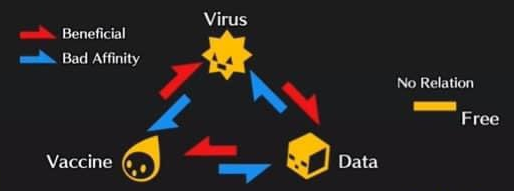
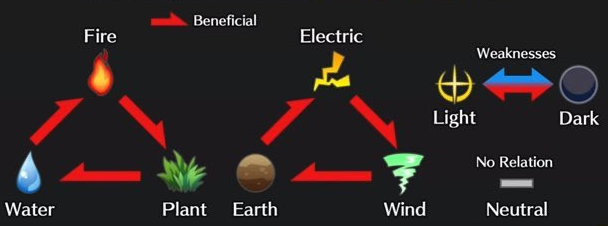
Damage also receives a multiplier depending on the Type and Attribute of a digimon in battle. Vaccine-type digimon 2x damage to Virus-type digimon, which deal 2x damage to Data-type digimon, which deal 2x damage to Vaccine-type digimon. Beyond that, if the damage also would deal additional damage due to the attribute of the skill being used against the attribute of the digimon being damaged, then the damage is multiplied by 1.5x. This means that using a Light attribute skill from a Vaccine-type digimon against a Dark attribute Virus-type digimon, the damage dealt is multiplied by 3x. While normally damage dealt in unfavourable Type matchups, such as Vaccine-type against Data-type, the damage is multiplied by 0.5x. If however, that damage was of a favorable attribute, such as a Fire attribute Vaccine-type attack against a Plant attribute Data-type digimon, then the damage will be multiplied by 0.75x.
While every digimon can use skills to deal damage, at any time a basic attack can be performed, dealing 50 physical damage with an attribute equal to the attribute of that digimon. (For instance, Agumon would deal Fire attribute damage, because it is Fire attribute)
Lastly, there are XROSS COMBOs. Every time a digimon issues a command, it gains 5 to its XROSS COMBO meter. any time a digimon uses a skill or a basic attack, the number in its XROSS COMBO meter becomes the percent chance that they initiate a XROSS COMBO should the next digimon in the timeline be their allies. Technically, it doesn't matter how many digimon "appear" in the XROSS COMBO. This might've been an oversight in programming by the developers, but we left it in for the authenticity of the PVP. The damage dealt, HP healed, or stats changed by skills such as Mental Charge Field are multiplied by the value of the XROSS COMBO. the XROSS COMBO chooses a number between 1 and 7, and adds the following value to the multiplier that is then applied to the value of the skill's effects:
1 +
0.8, 0.64, 0.512, 0.4096, 0.32768, 0.262144, 0.2097152
If the skill is a non damaging skill, then the values are:
0.5, 0.25, 0.125, 0.0625, 0.03125, 0.015625, 0.0078125
This is all done additively, so a XROSS COMBO of 3 would be a bonus of (1 + 0.8 + 0.64 + 0.512) for a total bonus of a 2.952 multipler for the skill's result. The chances that a XROSS COMBO goes beyond 1 additional value added to the multiplier are exceptionally low, and it doesn't matter how many digimon participate, which is why you can see how it seems likely that it was a programming oversight. For new players, just know that XROSS COMBOs almost always give 1.8x or 1.5x multipliers to skills. If the XROSS COMBO is a basic attack, then that many basic attacks are calculated instead, which may trigger support skills that apply status conditions such as Deep Sea Slumber or Poison Thorns, which does provide some utility to these otherwise underwhelming support skills.
Status Conditions
Each status condition lasts a range of turns, decided when the status if inflicted, with each turn spent afflicted by the status counting down the timer at the end of that turn. Each status condition has a skill that any digimon can learn that inflicts that status condition with 70% accuracy. They are as follows:
Panic Wisp Confusion: 2-4 turns Idle Bubble Sleep: 1-3 turns Ripping Net Paralysis: 4-5 turns Texture Blow Dot: 1-5 turns Venom Trap Poison: 3-4 turns Shock Stun: 1 turn Character Reversal Bug: Until the digimon dies or the status is removed with Restore or Ocean Love Support End Helpless: 5 turns
• Confusion causes the afflicted digimon to select an attack target randomly and basic attack that target. The attack targets can include not only its allies, but itself as well. It is often considered the most powerful status condition as it deprives an opponent's digimon of making a choice for its turn command for at least 2 turns. Equipment exist to protect digimon from status conditions, therefore, due to the predicted popularity of confusion as a status, Panic Barrier becomes a common single solution equipment for this status, making the other status conditions more relevant as alternatives in the opponent prediction metagame.
• Sleep simply stops a digimon from being able to issue a command until it wears off. This is the next best thing to confusion, and is often included alongside confusion as a means to circumvent Panic Barrier.
• Paralysis has a 50% chance to cause a digimon to be unable to issue a command for the turn. This is an unreliable disabling status, but when its inflicted, and when the paralysis stops the enemy from moving, its very welcome.
• Dot prevents a digimon from using skills, but allows it to use commands such as guard, change, and basic attack. A dotted digimon's stats are treated as 95% of their stats during all calculations while it's dotted. Because dotted digimon can still issue the change command, arguably one of the strongest commands in battle outside of skills, this status condition is decent though not often sought after.
• Poison deals 1/16 of a digimon's max HP stat as damage to it at the end of its turn. Each turn that a digimon is afflicted by poison, this damage increases from 1/16, to 2/16 (or 1/8), to 3/16, to 4/16 (or 1/4). This makes poison a viable damage dealing option for some digimon that don't have strong offensive potential.
• Stun doesn't "do" anything while its applied, it just exists so that the digimon can't have it applied again. When stun is applied the digimon's CD is doubled, moving it down the timeline. This means that to use stun effectively, reading the current CD on the timeline and managing your team's SPD is essential.
• Bug causes a digimon's type chart to reverse, so it will deal 2x damage against Data-type digimon if it was a Vaccine-type digimon and so on. If you are using a strange challenge team that is all the same type, you may need to rely on Character Reversal in order to create coverage against some digimon types.
• Helpless disables the effects of the target's signature skill. While this does not outright disable a digimon in battle, helpless gets around all status protections, meaning that it can provide minor disruption even against a fully protected digimon.
Fully protected? But there are so many statuses, and only a few equipment slots to add barrier equipment to, how can I be fully protected? Master Barrier along with a second Master Barrier means that status conditions' success rate against the equipped digimon are reduced by 100, meaning they have no chance to succeed (except for helplessness, of course). In the actual game, this equipment has a horrible mistranslation claiming that it only cuts the success rate of instant death, but it of course cuts the success rate of all statuses. In CSCEPVP all percent based calculations are additive until the calculation is applied. This means that adding two 50 cuts equals a sum total of a 100 cut to the success rate of statuses, rather than 50%, then 50% of the remaining 50% to equal 75%. This is important to keep in mind with things such as HIT Attach or even CRT Attach, as should they be combined with support skills or other equipment such that the hit rate or crit rate of a skill reaches 100, then that skill will always hit or always crit.
Earlier I mentioned that support skills such as Deep Sea Slumber or Poison Thorns are underwhelming but have some utlity. One great piece of utility is being able to use these support skills to read your opponent's equipment choices. How? If you basic attack a digimon, which may trigger these skills, whether it would have triggered that status condition or not, if the defending digimon has one Master Barrier as an equipment, if the Master Barrier blocks the status it will say RESIST, if it statuses them it won't say anything but they will be statused. if they have two Master Barrier equipped, or a barrier equipment like Sleep Barrier, then it will say BLOCKED. Digimon only have a finite number of equipment slots, so knowing that a digimon either has targeted protection against that status with one equipment, or two master barriers can inform your decision making on their other equipment choices, which is very important with Memetan Replica which will be discussed later.
Memetan Replica and the Equipment Meta
In the actual game, each account only has access to one Memetan Replica per save file. This equipment is absolutely game changing. Without it, powerful digimon like Sakuyamon would be totally vulnerable to penetrating signature skills such as Gift of Darkness from Belphemon RM which would in almost all situations erase all of its HP, even from full. It is because Memetan Replica fully protects against the damage from these skills that digimon like Sakuyamon, Dianamon, or Rosemon BM are even able to compete in the meta.
You'll notice that all of the above mentioned digimon that use Memetan Replica are Data-type digimon. This is because powerful Virus-type penetrating damage is common, therefore Data-type digimon typically most benefit from Memetan Replica.
Because Memetan Replica is such a centralizing equipment in the meta, and because it is limited to one per team, knowing where the opponent's Memetan Replica is allows you to use penetrating damage skills without risk.
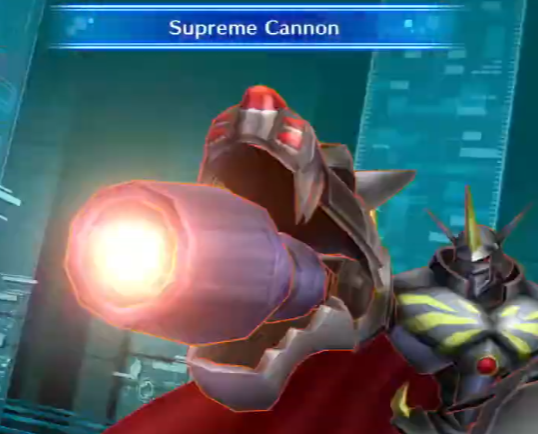
Take Imperialdramon DM for example. It's a very defensive digimon and can't be easily defeated in battle, but it only has 2 equipment slots. Will it equip two Master Barrier and find perfect protection from disabling status conditions, or will it equip Memetan Replica and not leave itself vulnerable to Supreme Cannon from Omnimon Zwart removing almost all of its HP in one turn? We could throw a penetrating skill at it and find out that way, but that would come with a huge CD and SP cost. If instead we pay attention to skills that have the side effect of possibly inflicting status conditions and look for RESIST or BLOCK, we will know if Imperialdramon DM has Memetan Replica equipped or not. If the readout said BLOCK, then both of the equip slots are spent on Master Barrier and penetrating damage is free to come through. Keep in mind that stat changes from skills such as Mental Break Field are not blocked by Master Barrier, just status conditions.
Building a Team
You made it this far through the article, now it's time to talk about team building. Generally, a team wants to lead with a Vaccine, Data, and Virus-type digimon, however, using 2 and 1, or 2 of the mentioned types and a Free-type digimon, is also a possible strategy, though it's less of a generalist strategy and more of a tech strategy. The diversity of types both in your opening 3 active digimon and in the rest of your team allows you to keep your options open during a battle and bring in digimon to assist in keeping your team viable throughout the course of a battle.
A key contrast between CSCEPVP and games like Pokemon is that battles are conducted between 3 digimon at a time. In pokemon it's historically been common that a pokemon like Snorlax in GSC, Talonflame in XY, or Landorus-T in SM in the respective OU metagames have been oppressive to the point that their domination of each of their metagames have flavored how all other pokemon must battle in order to legitimize their presence on a team. In Cyber Sleuth due to the 3v3 nature of battles, a digimon who would otherwise be so dominant are equally exposed to being targeted down by 3 enemy digimon. Furthermore, because all digimon have a memory cost when added to a team, it's not like including a digimon on your team comes with no risk like including a Lanorus-T does in the SM OU metagame in pokemon. Therefore, we see digimon like Lucemon SM or Susanomon who are extremely powerful but cost one quarter of your team's entire memory cost, are vulnerable to counter play such as Saint Knuckle from a Vaccine-type digimon to Lucemon SM or Panic Wisp to Susanomon who only has one equip slot and is therefore vulnerable to status conditions, being powerful options to include on a team that come with very readable and exploitable risks.
Generally speaking there are a few archetypes of teams that exist, though they exist on a spectrum and teams find themselves distributed between these archetypes as their designers see fit. Here are some of the basic team archetypes that are commonly seen, though others exist as well;
• Methodical INT Team: Sakuyamon, Seraphimon, and Lucemon SM are standard core digimon to this team. This team intends to play a drawn out battle, gaining advantages incrementally through leveraging the team's high INT to heal and defend from magic damage and potentially even more through skills such as Mental Charge Field.
• Physical Aggro Team: Dorugoramon, Darkdramon, and ShineGreymon BM are some of the heaviest hitters for their respective types. Contrasted to the high INT team, physical aggro teams aim to end a battle fast by dropping enemy digimon often times from full HP to zero in one or two attacks.
• Combo: Often times combo teams use a mix of strategies, such as ShineGreymon BM with Sakuyamon, changing ShineGreymon BM out of the battle when necessary and often leveraging a larger quantity of lower memory digimon such as Terriermon, WarGrowlmon, or Tankmon to juggle an opponent, expending the CD of their team while keeping the enemy team from catching up, making the best use of each digimon's unique niche against the opponent.
Failing to include at least one digimon with equipped with at least one Master Barrier and possibly Restore will leave a team completely vulnerable to a team dedicated to inflicting status conditions with low memory digimon.
Teambuilding in Cyber Sleuth is uniquely dynamic as the digimon you choose right down to the skills, equipment, and stats that you give them, has more to do with the other digimon on your team than it does with whatever species that digimon is. Often times in games like pokemon, there are "optimal" movesets and stat distributions for pokemon, but in Cyber Sleuth this is rarely the case. A digimon on a team in Cyber Sleuth can be thought more of a piece of a team rather than an individual unit in all cases. The stats that this digimon brings will represent the defensive capabilities of the team as well as its offensive capabilities, the skills that it carries determines when and what your team can do to resist certain strategies, and overall, each digimon on a team when designed correctly should have its stats, skills, and equipment added to it with respect to the other members on its team and their needs and covering their vulnerabilities.
Staple Strategies
There are many important tools that a tamer must know in order to succeed in Cyber Sleuth PVP. Being aware of these strategies will not only allow you to use them, but will stop you from being caught off guard by an opponent who is employing them. Almost all digimon will use Physical Drain or Spirit Drain in almost all cases. If a battle goes on long enough, and unless you are using a hyper offensive team, most battles will, you will need to recover SP in order to keep using skills, therefore the drain skills are probably the most commonly used staples among all skills.
Acceleration Boost is an extremely important skill for digimon who play a damage dealing role. Being able to take two turns worth of attacking and put them into one helps maintain SP and CD cost of the attacking skill, but also causes all of the damage to be received by the opponent at once, making it harder to heal and mitigate the incoming damage. Acceleration Boost also allows for a digimon to position itself on the timeline where its favorable before committing to dealing damage.
Similar to Acceleration Boost, Chain Max can also increase the effect of your team's skills, however you can target your teammates with it as well and it can increase the power of healing or stat boosting skills. The bonus to damage is less than Acceleration Boost and requires adjacent teammates in the timeline in order to use the bonus. However, it allows supporting digimon to buff the output of its teammates, or allows digimon to support when trying to defeat a digimon with an otherwise disadvantageous type matchup. The XROSS COMBO from Chain Max also brings utility in enabling combo plays, and in the fact that XROSS COMBOs can't miss, helping bring a multi-utility tool for teams that stack EVA.
Lastly, and this one's a bit strange, but you may have noticed that some digimon have signature skills that prevent them from issuing a command on their next turn due to recoil. These digimon include Armageddemon, Diaboromon, Dorugoramon, WarGrowlmon, Tankmon, and TyrantKabuterimon. While this can be a massive downside, there are a few ways to ignore this recoil and proceed with their next turn as normal. For one, if the digimon dies and is revived, then they can move on their next turn. The other one involves what is most likely an engine exploit of the game. In the actual Cyber Sleuth game the execution of this is a little convoluted, but it's been simplified for the simulator. If a teammate issues the change command for their action for turn, then an allied digimon suffering from recoil will be able to move on its next turn. If a digimon with recoil was changed to the reserve digimon then brought back into battle through an emergency switch in when all active digimon are defeated, it will still suffer from recoil however.
Mistakes to Avoid (Especially if Coming from "Other Games" 😉)
"One-Shotting"
While in other games bringing a target from full HP to zero is often an amazing situation, in Cyber Sleuth it ranges from good to in some cases detrimental. Revive and Perfect Revival are skill found on likely every team, so death isn't permanent in Cyber Sleuth unless it's the final digimon on the enemy team. But how can death be not only not that big a deal, but potentially even beneficial to the opponent?
If a digimon dies, its CD freezes. If it's CD was very low, then when its revived later, it will appear at the very top of the timeline, letting it instantly taking a turn and attacking without the risk of having to survive in battle until it's turn comes.
Furthermore, killing a digimon isn't free. If you kill a digimon with an explosive turn, but it cost you massive CD, and in retaliation, your attacking digimon is defeated, then you have a digimon that died with high CD and can't be easily revived back into battle while the opponent had a digimon that died with low CD and can be easily be revived back into battle.
While in other games death is final, in Cyber Sleuth what's more important than killing the opponent's digimon is scoring valuable kills against the opponent such that it becomes harder to recover the battle until the task becomes impossible for them.
"Theming"
This one doesn't have to be a mistake as it can just be a thematic choice, and because Cyber Sleuth is such an open-ended game, it can be a totally valid choice to generate victories as well. That being said, try to be cautious building teams based around running only one attribute of digimon, or stacking support skills like Dragon's Roar and Digital Hazard that boost a certain kind of attribute damage.
While it's certainly welcome whenever this added damage is brought to a team, a powerful attack typically deals 600-1000 damage, if you boosted this by 25% by using both of the aforementioned support skills at once, you'd deal 150-250 more damage. That's not no damage, but it's not a massive amount of damage either, and the damage does stack up over the course of a battle, however, choosing support skills that boost attribute damage over choosing digimon that better support each other can cause you to miss out on stronger synergies.
Take TyrantKabuterimon for instance, with it's Nature Spirits support skill. Because of it's support skill, using Crescent Leaf does in fact make sense as it will benefit from the damage boost for no cost, but choosing other allies with plant attribute signature skills only to take advantage of this support skill may overlook the other synergies that may compliment TyrantKabuterimon as a digimon overall. Again, if you choose to create a Plant attribute team or a Water attribute team, then that's different, but don't look at TyrantKabuterimon and think that because he has Nature Spirits that he therefore must exist on a plant attribute damage team. Let the support skills be bonuses to your strategies, not limitations to what you do with your team.
Furthremore, let's take a digimon like Darkdramon. It's electric attribute, so it takes more damage from Earth attribute skills. Should you run Sand Guard DX on it to help protect against bad type matchups? Almost certainly not! Earth attribute damage from Vaccine-type digimon is extremely rare, so Sand Guard DX would do very little for Darkdramon even though Earth attribute damage would deal more damage to it if it were to be hit by an Earth attack. Even though Earth attribute damage is what would deal the most damage here, Light damage is far more common as a threat due to Saint Knuckle being a common skill used by Vaccine-type digimon to target down Dark attribute Virus-type digimon. Therefore, Shine Guard DX is a better counter to Vaccine-type damage for Darkdramon even though Earth attribute damage would deal more damage to him if it were to hit him.
Over-Estimating Stat Boosts
In our favorite parallel PVP game, moves like Swords dance or Dragon Dance have often been incredibly powerful moves in PVP. In Cyber Sleuth Attack Charge Field or Speed Charge Field provide only a 10% bonus to stats. This means that stat stacking requires either a XROSS COMBO or many turns of investment in order to provide noticable results, it's very much unlike pokemon where one stat boost changes the dynamic of a battle.
The biggest exception to this trend is Mental Charge Field and Mental Break Field, as INT serves a dual purpose of offense and defense, meaning that in a INT vs INT strategy matchup, the charge fields for INT provide a larger impact to the relevant stats during a battle.
Mental Charge and the skills that aren't the field variants of the stat boosting skills also have utility because they are tied among other commands for having the lowest CD cost of 8000, allowing a high SPD investment digimon to be able to spam a skill like this targeting one of its allies providing strong support utility.
One more example to the typical trend for stat boosting would be digimon with the Fairy Protection support skill, which further boosts the stats received from charge skills. Teams built around bolstering the benefits of stat boosts are a niche and viable strategy, but in general stat boosts are not wise investments on most teams.
"Stabbing"
There is no same type attack boost, or STAB, in Cyber Sleuth. In pokemon, its often that a pokemon will want to use a Water move if the pokemon is water as the damage output is multiplied by 1.5x, but in CSCEPVP, if MetalGarurumon uses Hydro Water, by default it doesn't do any more damage than if it had used Comet Hammer or Wind Claw. This means that picking inherited skills to complement a digimon's signature skill doesn't really come down to the attribute of the digimon in question, but rather, the digimon that you expect you will want to, or need to, deal bonus damage to.
In the case of a Data-type digimon, often times additional pressure against Vaccine-type digimon is valued, and the most commonly seen attribute amonst Vaccine-type digimon is the Light attribute. Therefore, Destruction Cannon or Nightmare are more valuable choices for a Data-type digimon, generally speaking, than an inherited skill that happens to share the same attribute as that digimon. When picking inherited skills for damage, you are choosing skills based on what you will need in order to deal more damage to enemies, not necessarily based on what digimon you have.
That being said, should your team have plentiful boosts to Light attribute damage through support skills such as Justice Genome or Moon-Kissed Blade, then there may be a situation where choosing to use a Light attribute inherited skill over a targeted attribute skill may provide more general damage at the cost of the larger 1.5x multiplier against common strong matchups.
Another mistake a player can make is combining theming with stabbing and choosing Wolkenapalm on their Water attribute digimon, thinking that the bonus damage against Plant attribute digimon will prove to be essential. It may be that this choice is a great decision for some matchups or specific expected encounters, but this is generally not the strongest choice. Unlike in pokemon for instance, Water attribute damage does not deal reduced damage to Plant attribute digimon, so bringing Fire attribute damage for coverage is not needed. Attribute based damage is mostly an offensive consideration.
The most commonly seen digimon of each type are as follows, opposite attribute skills on opposite Type digimon are therefore typically strong choices for inherited skills;
• Vaccine: Light, it's by far the most common attribute for Vaccine-type digimon, though ShineGreymon BM is a powerful digimon, so the odd Water attribute skill from enemy Data-types does have its utility too.
• Data: Light, though this is not so much that it is the most commonly seen attribute for this type, as Data-type digimon are more varied in their attribute identities, but just that being able to deal extra damage to the largely important Sakuyamon is a strong motivation for choosing Dark attribute skills.
• Virus: Dark, most Virus-type digimon are Dark attribute, this shouldn't be too surprising thematically. The fact that most Vaccine-type digimon are Light attribute and utilize Light attribute signature skills creates a metagame where Virus-type digimon are often slightly pushed out of defensive playstyles and into more aggressive roles, though many exceptions exist such as Lucemon SM.
Lastly, Believing this YouTube Video
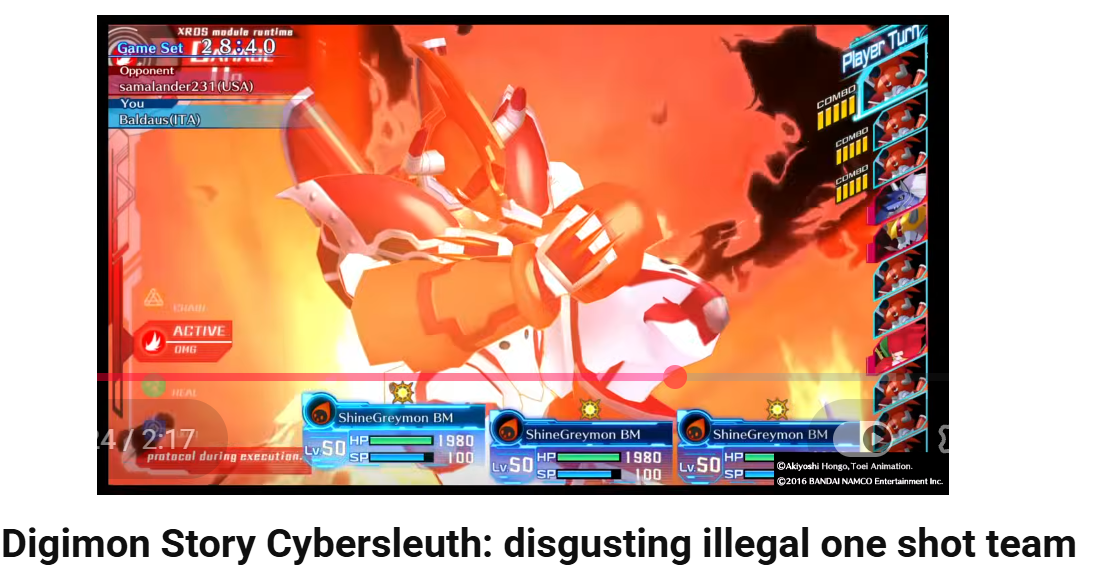
Unfortunately, the YouTube algorithm loves to promote this video, however it no longer represents a possible PVP battle in Cyber Sleuth. If you bought Cyber Sleuth on Switch or on Steam, then this video shows a battle that takes place in a patch of the game that is so old that you cannot even possibly play it on Switch of Steam. Needless to say, CSCEPVP.com uses the most up to date patch of the game, and yes, that means that this "Digimon Story Cybersleuth: disgusting illegal one shot team" is in fact very "illegal" as it cannot even exist under normal PVP rules, or under the most recent patch of the game.
If you want up to date information on Cyber Sleuth PVP on YouTube, I'd suggest checking out the reccomended channels on the front page of CSCEPVP.com. Most of the top competitive players communicate with each other and most of them post content on YouTube or Bilibili, and there is a strong ecosystem of the highest ranked players between there and various forums online. In case you're curious, Kenzy, the author of this article and many other articles on the website was ranked 19th highest on the Switch PVP matchmaking system.

 Discord
 PVP Battle!
 Team Builder
 Online World
 Digimon Info
 Skills
 Damage Calc
 Field Guide
 Profile
 Users




 Mental Charge
 Final Shining Burst
 Perfect Revival
 Memetan Replica
 Agumon


 Idle Bubble
 Ripping Net
 Texture Blow
 Venom Trap
 Shock
 Character Reversal
 Support End
 Panic Barrier
 Master Barrier
 HIT Attach
 Sleep Barrier
 Sakuyamon
 Gift of Darkness
 Belphemon RM
 Dianamon
 Rosemon BM
 Imperialdramon DM
 Omnimon Zwart
 Lucemon SM
 Susanomon
 Seraphimon
 Dorugoramon
 Darkdramon
 ShineGreymon BM
 Terriermon
 WarGrowlmon
 Tankmon
 Armageddemon
 Diaboromon
 TyrantKabuterimon


 Sand Guard DX
 Shine Guard DX


 MetalGarurumon


